- MANUFACTURER: The G.H. Curtiss Manufacturing Company
- MANUFACTURED: Hammondsport, NY, USA
- YEAR: 1909
- MODEL: Roadster
- ENGINE: 35 cu. in. V-Twin, Air-Cooled
- HP: 6
- ENGINE NO: 3302
- TRANSMISSION: Belt Drive
- CARBURETOR: Curtiss
- FRAME: Standard
- SEAT: Persons Manufacturing Co. of Worcester, MA
- SPEEDOMETER/ODOMETER: Stewart Magnetic Type
- CLOCK: Ingersoll Watch Company, Yankee Model
- HEADLIGHT: Twentieth Century Mfg. Co. Lamp Model No. 102 of New York City
- COLOR: Special-order black enamel paint applied in four layers
- BRIGHT METAL: Nickel-plated except aluminum
- FEATURES: Tool Bag, Speedometer/Odometer, Headlamp, Clock, License Plate
FROM THE DICK SHAPPY COLLECTION:
The 1909 Curtiss V-Twin “Roadster”
Despite becoming known as the “fastest man on earth” in 1907 for setting a land speed record of 136 mph on an
experimental V-8 motorcycle he had built himself, Glenn Hammond Curtiss was not known for his bikes, but rather as
an American aviation pioneer. Born in 1879 in Hammondsport, New York, he started his engineering career racing bicycles
in his youth. By 1901, he built his first motorcycle with an engine of his own design, and his genius only expanded
from there. The sixth engine he ever produced, a single-cylinder under the name
“Hercules,” can also be found in
the collection of Dick Shappy. (You can read about it at DSClassics.com) He quickly found that “Hercules” was
already patented, and his future endeavors would begin the Curtiss line.
According to Richard Leisenring, former curator of the Glenn H. Curtiss Museum in Hammondsport, NY, and author of
Curtiss Motorcycles 1902-1912, “During his early experimentation, Glenn learned two crucial points that made his
motorcycles successful. First was the weight-to-speed ratio. Second was lowering the center of gravity on his
machines, which substantially increased efficiency and speed.”
He developed the first American V-twin engine in 1903, setting a world speed record with it that year, and inspiring the
industry. Competitors Indian Motorcycles would go on to offer their first two-cylinder engine in 1906, followed by
Harley-Davidson in 1909. In 1904, he was taking home the gold against even his rivals at Indian Motorcycles,
and put his 9 HP V-twin engine into the first successful dirigible in the United States, the California Arrow. By
1907, Glenn had quite a few world records under his belt, including an unofficial land speed record of 136 mph on an
experimental V-8 airplane engine-powered bike on Ormond Beach. In 1908, G.H. was the first in America to make a
preannounced, officially recognized, publicly observed flight.
Until 1912, he and his team would go on to build, sell, and race motorcycles out of their Hammondsport garage, but
this wasn’t his only successful endeavor. In the same period, Curtiss was the chief rival of the Wright brothers,
designing airplane engines, the most widely used U.S. aircraft in WWI, the first amphibious aircraft, and joining the
Aerial Experimentation Association. Curtiss was one of the great engineers of the early 20th century, producing
innovative and high-performance motorcycles, popularizing the handlebar throttle, and helping to create the U.S.
aviation industry. There is no doubt that if G.H. Curtiss had pursued the development of the motorcycle with the
same enthusiasm he put into aviation, the industry would look far different today.
This 1909 Curtiss V-Twin Roadster is an extremely rare specimen, considered the “Duesenberg” of early American
motorcycles. A powerful air-cooled engine rated at 8 to 10 horsepower with splash oil lubrication and a dry-cell
battery ignition was produced at the G. W. Curtiss Manufacturing Company in Hammondsport, New York. The
Audrain Auto Museum reports that this 1909 Curtiss is one of the most well-preserved motorcycles in the world
today and the last of the Curtiss line.
There are few Curtiss engines known to have survived, but there are several in the Dick Shappy Collection, including the
Hercules and the
1906 Curtiss V-Twin.
This one, engine number 3302, went to Dale Stoner in collaboration with the
Glenn H. Curtiss Museum in Hammondsport, NY, for a careful and meticulous restoration and documentation. Dale
Stoner is not only the premier Curtiss historian and a master machinist, but an engineering pioneer who will one day be
regarded in the history books right alongside Glenn. He is currently recreating the beautiful and historic 1907 Curtiss
8-cylinder experimental motorcycle that set the world land speed record of 137 MPH in exacting detail. It has been
rumored that upon completion, this vehicle could be worth between $500,000 and $1 million.
Advertisement for the Curtiss Carburetor, 1907, as seen in
Curtiss Motorcycles 1902-1912
“Carburetor
Price, $8
Capacity. For engines having dimensions not exceeding 3 ½ x 3 ½, 8/4” pipe construction
This carburetor is central draft with a central gasolene supply. Perfectly automatic. Has an adjustable
automatic air supply, and is better adapted for motorcycle use than any other carburetor
It will not shake up and give bad mixture while going over rough places; will not flood, slop gasolene, and will not
freeze in cold weather
This carburetor is not only very neat in appearance, but is light and compact. It weighs but 15 ounces, and embodies all
the most up-to-date features of scientific carburetor construction” (Pg. 105)
Check out master machinist and Curtiss historian Dale Stoner reflect on Glenn Hammond Curtiss’s motorcycles and
show off his 1907 Curtiss V-8 land-speed-record-setting replica on
Jay Leno’s Garage:
“The Fastest Man on Earth: 1907 Curtiss V8 Motorcycle.”


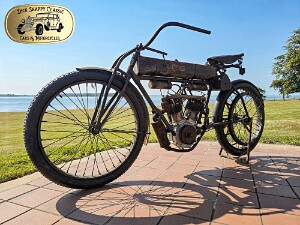 1906 Curtiss V-Twin
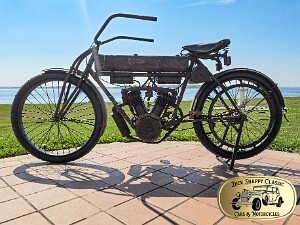 1908 Curtiss V-Twin
 1917 Curtiss OXX-6 Aero Engine Race Car
 1970 Harley-Davidson Belly Burner Dragster
 1907 Fabrique Nationale 4
 1912 Henderson 4
 1962 Harley-Davidson Sportster XLCH Custom Engine Belly Burner Dragster
 1911 Yale American Single
 1912 Pope Model H 2 Single
 1965 Harley-Davidson Sportster XLCH KHK Frame Custom Engine McClanahan DragsterSee similar Curtiss motorcycles for sale